Supplement certification logos: verify the exact product and scope
Look up a supplement certification with the issuing program and keep product identity, program scope and clinical claims separate.
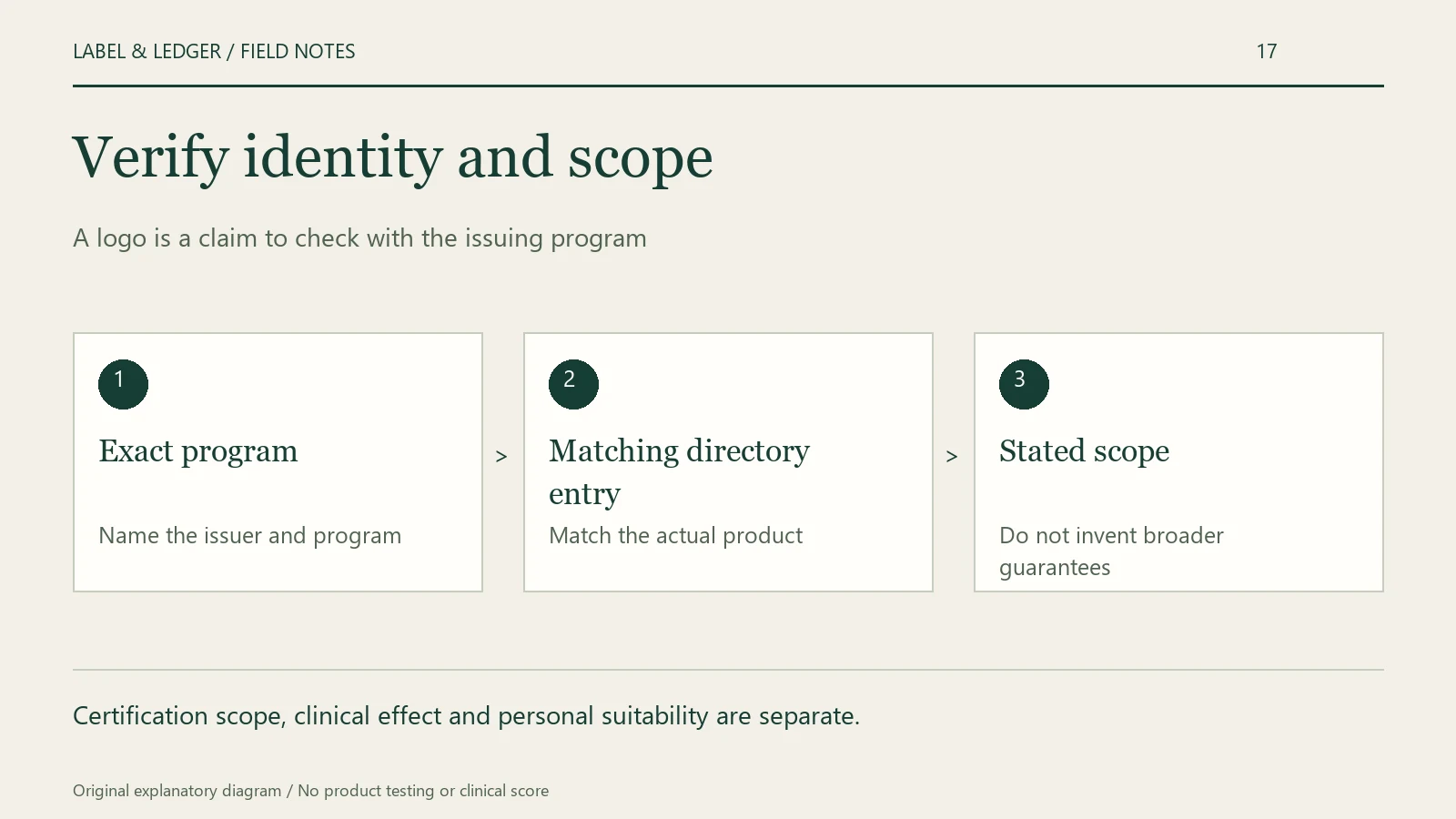
Verify a supplement certification by using the issuing program's own directory and matching the exact product, not merely recognizing a logo in a listing image. Record the program name and what it says it evaluates. Certification scope, clinical effectiveness and personal suitability are different questions. This guide explains a verification workflow without awarding a universal quality score or claiming that any mark guarantees a health outcome.
Identify the exact claim on the package
Copy the words around the mark as well as the program name. A statement about an ingredient specification, a facility or a finished product may refer to different things. Do not treat every reference to a standards organization as the same certification. If the image is too small to read, request a current readable package image before drawing a conclusion.
Keep the claimed product name, flavor, form and package identity in your worksheet. A brand may sell several products, and a listing for one should not silently establish the status of another. A logo copied into a seller description is a claim to investigate. It is not the independent lookup itself. Preserve the distinction between claimed status and verified directory result.
Use the certifier's own starting point
Go to the organization's official website or directory instead of relying solely on a retailer's outbound link. NSF maintains a Certified for Sport product search. If that is the program claimed, search there for the exact product and read the matching entry. This website does not maintain or reproduce the directory and cannot guarantee that a past lookup remains current.
For other marks, locate the issuing organization's official explanation and any applicable product lookup. A similar name or visual style is not enough. If you cannot identify the issuer, write that as an unresolved question. Do not invent a certification category to make an unfamiliar badge fit a familiar framework. The seller or manufacturer should be able to explain the specific claim it makes.
Match the directory entry carefully
Compare the product name, formulation details and any identifiers the program provides. If the program distinguishes lots or other variants, follow those distinctions rather than assuming the whole brand is covered. Keep the date of your own search and a record of the entry you used. A lookup is a time-bound observation in your records, not a permanent statement by this site.
| Verification step | What to record | What remains separate |
|---|---|---|
| Identify mark | Issuer and exact program | Similar-looking badges |
| Search official directory | Matching product entry | Retailer claims alone |
| Read scope | What the program evaluates | Clinical effectiveness |
| Resolve mismatch | Written question and response | Guessed equivalence |
| Preserve lookup | Your capture date and source | Future status changes |
If no result appears, first check spelling and variant details. A failed search does not automatically establish fraud; it may reflect a search mismatch or another issue needing clarification. Ask the issuer or manufacturer a precise question with the package details. Keep the status unverified until the discrepancy is resolved, rather than choosing a confident conclusion in either direction.
Read what the program actually covers
NSF describes Certified for Sport as a program addressing sports products and banned-substance risk, among its stated evaluations. Read its own current scope rather than converting the mark into a promise that a supplement is risk-free. A certification can answer defined quality or screening questions without establishing a personal need for the product or every marketing claim made about it.
Do not expand a program's wording to include outcomes it does not state. If a page says certain attributes are evaluated, record those attributes. Avoid writing approved by doctors, medically proven or guaranteed safe unless the specific statement is both supported and applicable; this site makes none of those claims. Scope discipline is more informative than a generic trusted badge.
Keep clinical and sport questions distinct
If you participate in a sport with anti-doping obligations, consult the relevant official rules and qualified support for your situation. A general shopping guide cannot determine your eligibility responsibilities or guarantee a product carries no risk. The directory lookup is one information step. It does not replace understanding the applicable program, exact product and circumstances.
For personal health questions, take the actual label and certification claim to a healthcare professional. A verified mark does not make ingredient overlap or medicine interactions irrelevant. The price comparison remains separate too: a certified product can have a higher or lower entered unit cost, but the certification should not be converted into an invented dollar premium or numerical health score.
Record the conclusion narrowly
A useful conclusion says that the exact product was found in the named official directory on the date you checked, with the stated scope. If a mismatch remains, say what did not match. Avoid a blanket brand endorsement. The narrow statement is easier to update, inspect and discuss with the issuer than a broad assertion that the brand is certified in every respect.
When revisiting a purchase, check again if the product or label has changed. Preserve earlier records rather than assuming a familiar bottle means the same formulation. The workflow is valuable because it makes identity and scope explicit, not because it produces a permanent seal of certainty.
FAQ
Is a logo in a marketplace photo enough?
No. Treat it as a claim and verify the exact product through the issuing program's official resources.
Does certification prove clinical effectiveness?
Do not assume that. Read the program's stated scope and investigate health claims separately.
Does a missing search result prove the seller is deceptive?
Not by itself. Check matching details and ask the issuer or manufacturer before drawing a conclusion.
Sources
- NSF: Certified for Sport program — program scope.
- NSF Certified for Sport product directory — exact-product lookup.