Supplement subscriptions: calculate the refill cost and interval
Separate first-order discounts, later deliveries, inventory and cancellation questions before treating a subscription as a saving.
Evaluate a supplement subscription by comparing the full cost and timing of the orders you expect to receive, not only its first-order price. Record the recurring package, refill interval, future price conditions and cancellation process from the actual offer. Then compare that schedule with a one-time purchase scenario. This is a budgeting method, not a statement that subscriptions are always cheaper or a legal interpretation of any specific seller's terms.
Create a schedule before a savings figure
List each expected order date within a defined planning period. Use the delivery interval stated by the seller rather than substituting a convenient monthly assumption. Every 30 days, every four weeks and calendar-month delivery describe different schedules. A worksheet should state its starting date and ending boundary so an order on the last day is not included inconsistently.
For a rough scenario, you may choose a 180-day horizon and write the specific assumed deliveries inside it. Label that scenario rather than calling it an annual fact. If a seller permits skipping or changing intervals, record how you would use that option, but do not assume an action will happen automatically. A planned skip and a confirmed skip are different records.
Keep the introductory price separate
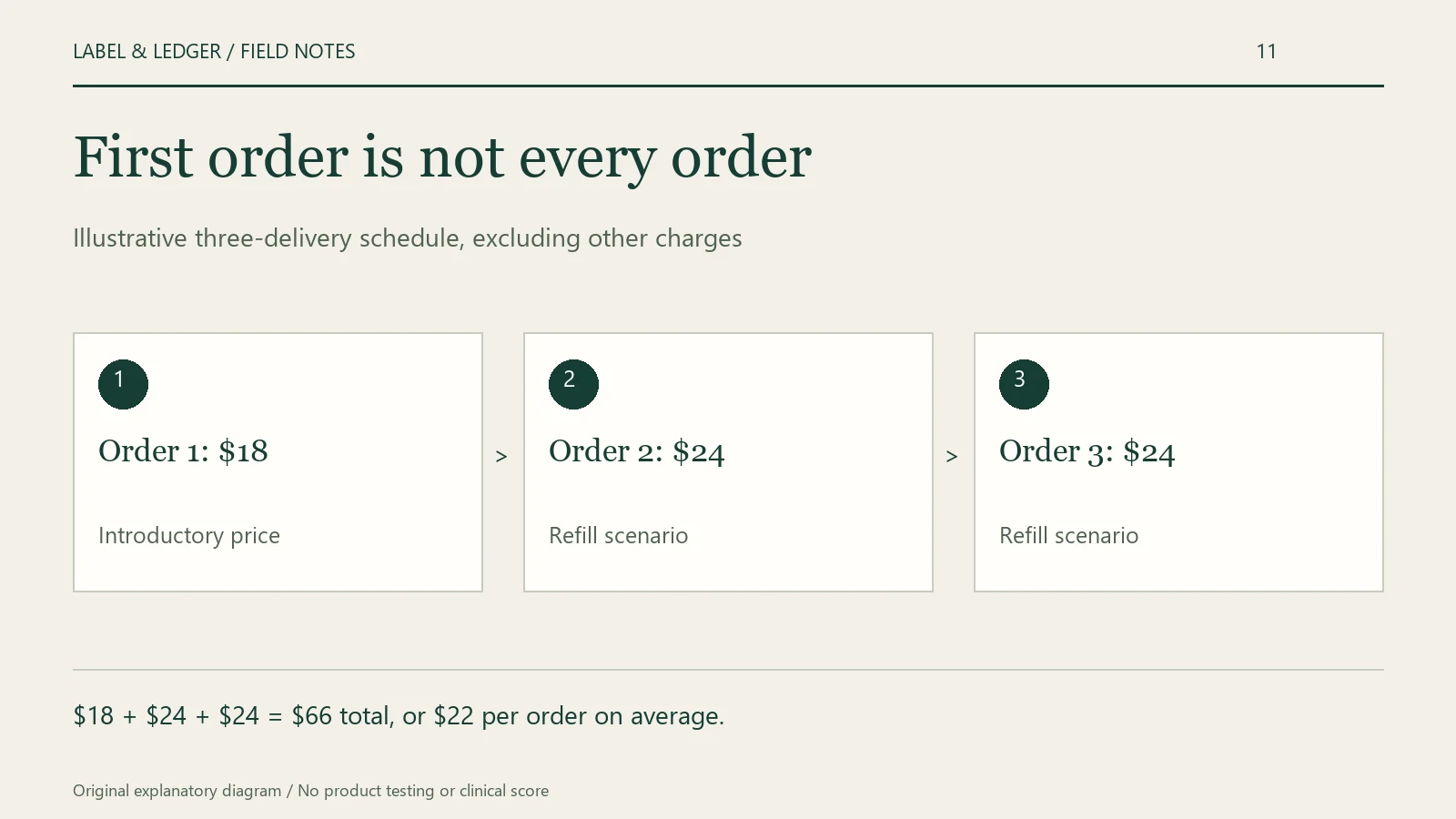
Consider an illustrative schedule of three orders: the first costs $18 and the next two cost $24 each, with no other charges in this simplified example. Total cost is $18 + $24 + $24 = $66, or $22 per order on average. Describing the subscription as $18 per order would apply the introductory price to orders that do not share it.
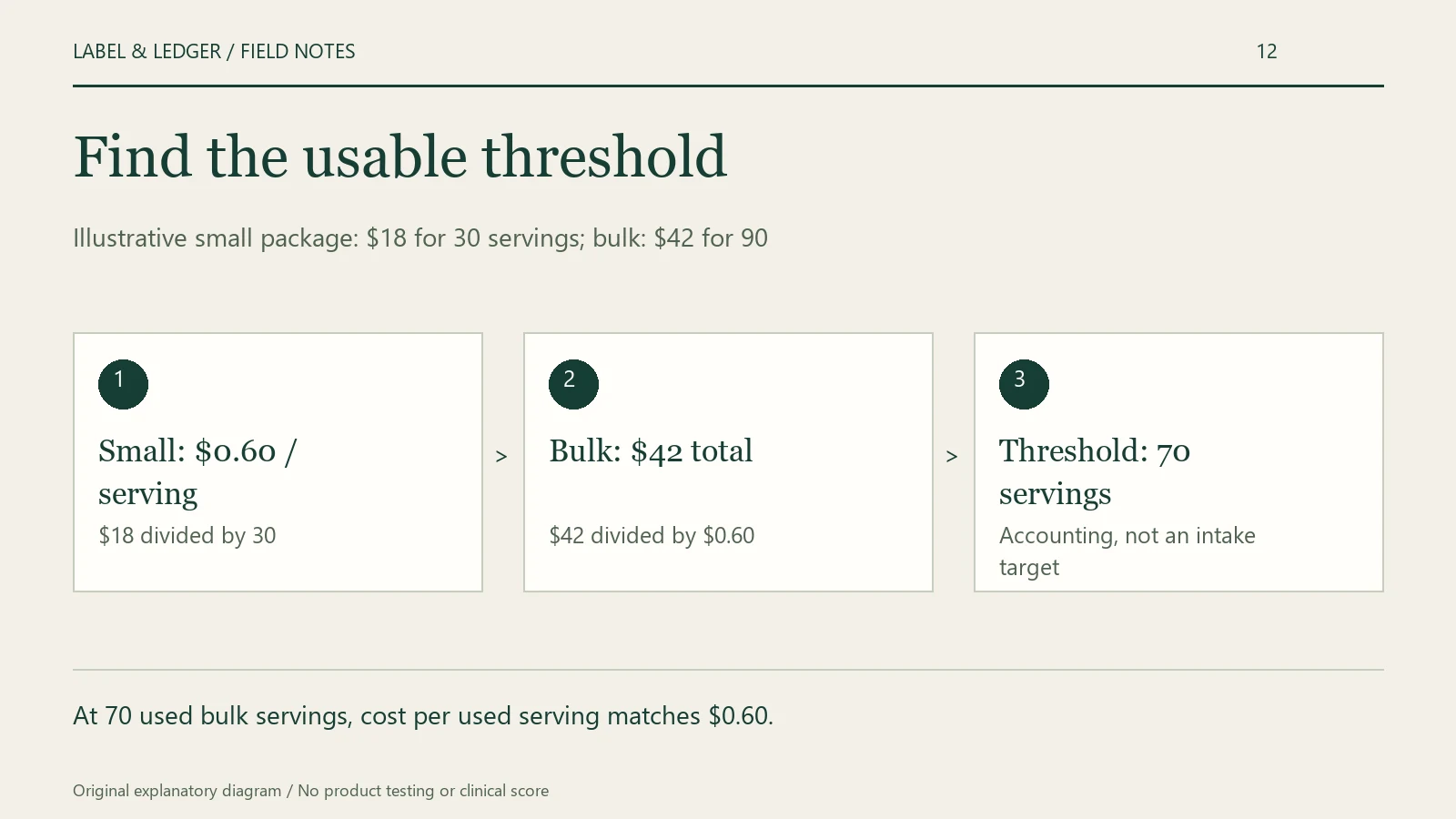
If each package contains an illustrative 30 labeled servings, those three deliveries supply 90 servings at a scheduled purchase cost of $66 ÷ 90, or about $0.7333 per serving. This calculation assumes identical packages and excludes waste. Check each refill's package identity, because a changed count or formula can make the old denominator unsuitable even if the order price stays the same.
| Illustrative order | Checkout cost | Servings supplied |
|---|---|---|
| First | $18 | 30 |
| Second | $24 | 30 |
| Third | $24 | 30 |
| Total | $66 | 90 |
Compare purchases with expected use
A delivery schedule can supply more than you expect to use. At an assumed one serving per day, a 60-serving bottle delivered every 30 days adds inventory unless you change the schedule. This is a supply calculation only; do not change actual intake to match deliveries. Keep starting inventory, new servings received and expected servings used in separate columns.
For each delivery, calculate inventory before and after receipt, then subtract expected use until the next delivery. If inventory steadily grows, investigate whether the interval can be changed or whether the arrangement fits your budget. An apparently low unit price can be unattractive if it creates unwanted stock. Avoid assuming you will eventually use everything without considering the label date and storage requirements.
Inspect the terms that affect your scenario
Before enrolling, record where the recurring amount is stated, how future price changes are communicated, how to cancel or skip, and any timing cutoff. These are questions to answer from the actual current offer, not universal terms this website can provide. Save the relevant confirmation and instructions in your own records. If an essential condition is unclear, ask the seller before authorizing recurring payments.
Do not rely on a general brand FAQ when the checkout describes a different subscription program or marketplace seller. Identify which party handles payment and cancellation. A product manufacturer and a marketplace may have different operational roles. Keeping those roles visible helps direct a question to the correct party without implying anything about their legal responsibilities.
Compare with a realistic one-time alternative
Build the one-time scenario with the same product quantity and time horizon. Include its actual shipping and discounts. Do not compare three subscription deliveries against one bottle bought once unless you clearly explain the different supply. Conversely, do not assume repeated one-time delivery fees if the alternative would be one planned bundle order. Compare complete, plausible baskets.
When future prices are uncertain, use scenarios rather than a guaranteed savings claim. A worksheet might show unchanged refill prices and a separately labeled higher-price case chosen by you. The scenario percentages are not predictions. Their purpose is to show how sensitive the result is to assumptions and help you decide whether more information is needed.
Keep a cancellation record
If you later cancel, retain the request and any confirmation. Check subsequent order and payment records against that confirmation. This is practical recordkeeping rather than a promise that any particular action resolves a dispute. For an unresolved transaction issue, use the relevant seller, payment provider and official consumer resources. Do not share payment details or sensitive health information with this website; its tools do not need them.
FAQ
Can I treat the first-order price as the monthly budget?
Only if the relevant orders actually have that price. Separate introductory and recurring amounts before averaging.
Should I increase use to avoid stockpiling?
No budgeting result is a reason to change personal use. Ask an appropriate healthcare professional about use and adjust purchasing separately.
Does this guide state cancellation law?
No. It provides a terms checklist and arithmetic method. Verify current requirements with official resources for your situation if needed.
Sources
- Federal Trade Commission — consumer-protection information and complaint resources. All schedules and prices here are illustrative, not observed subscription terms.