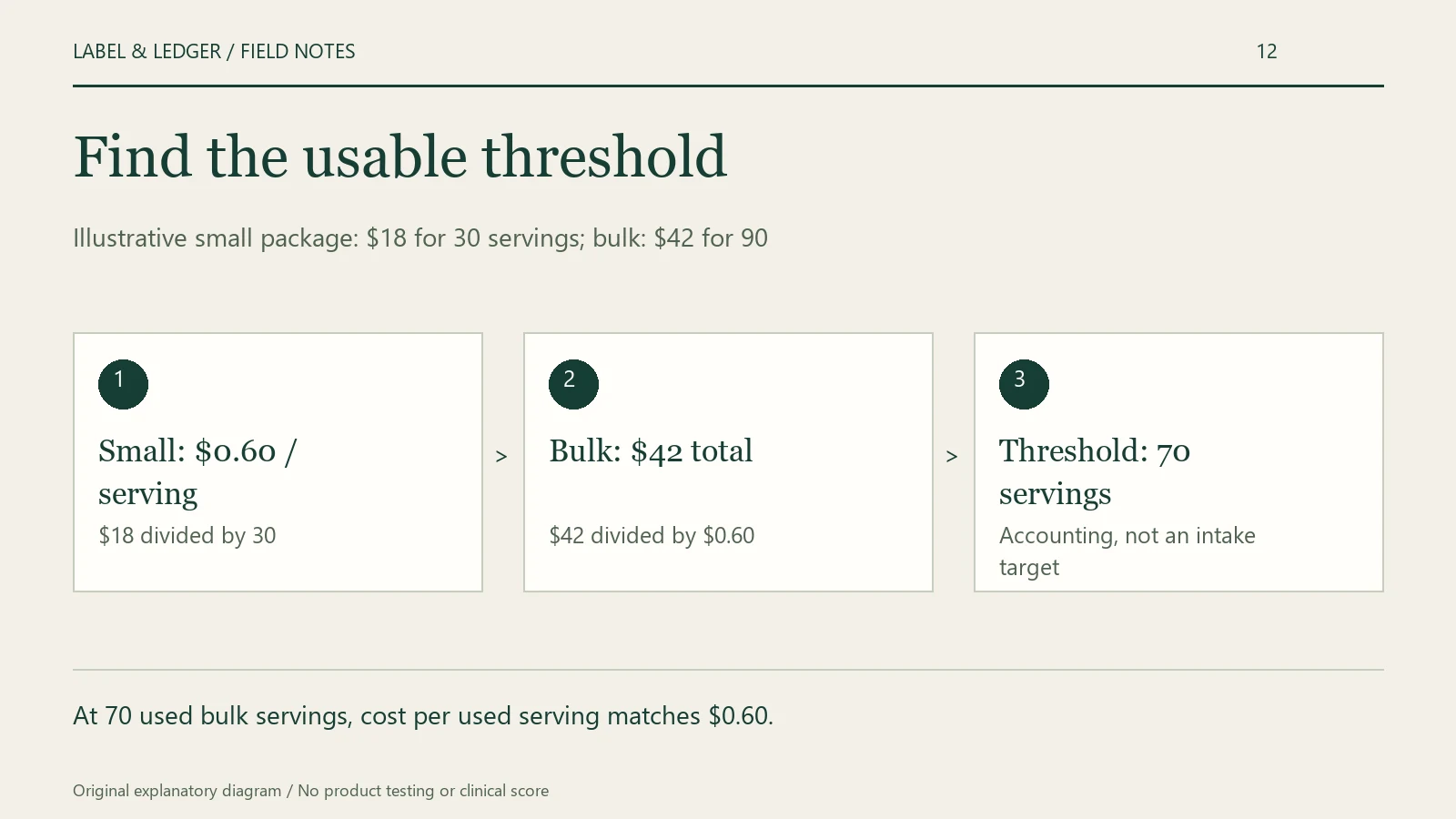
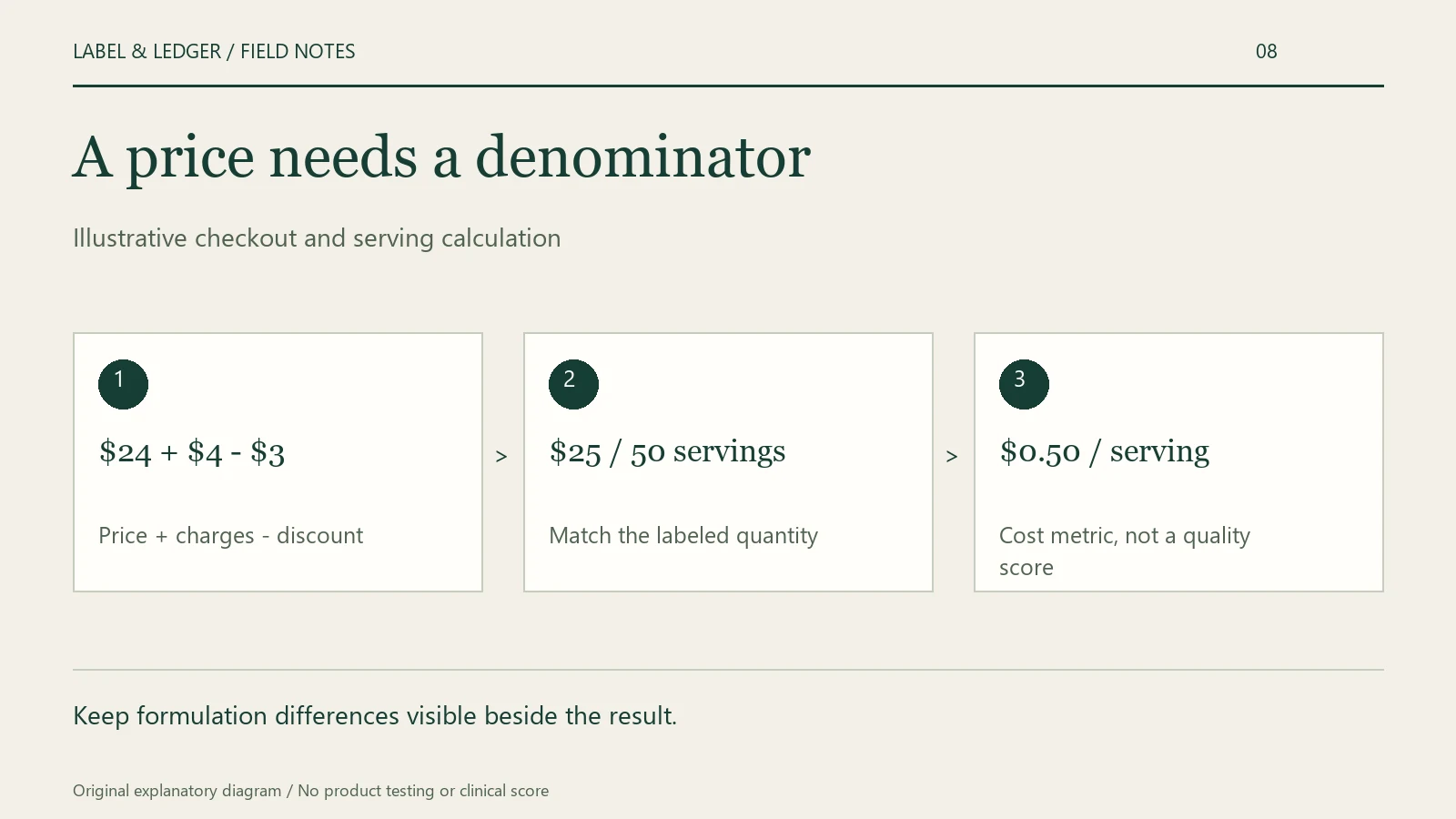
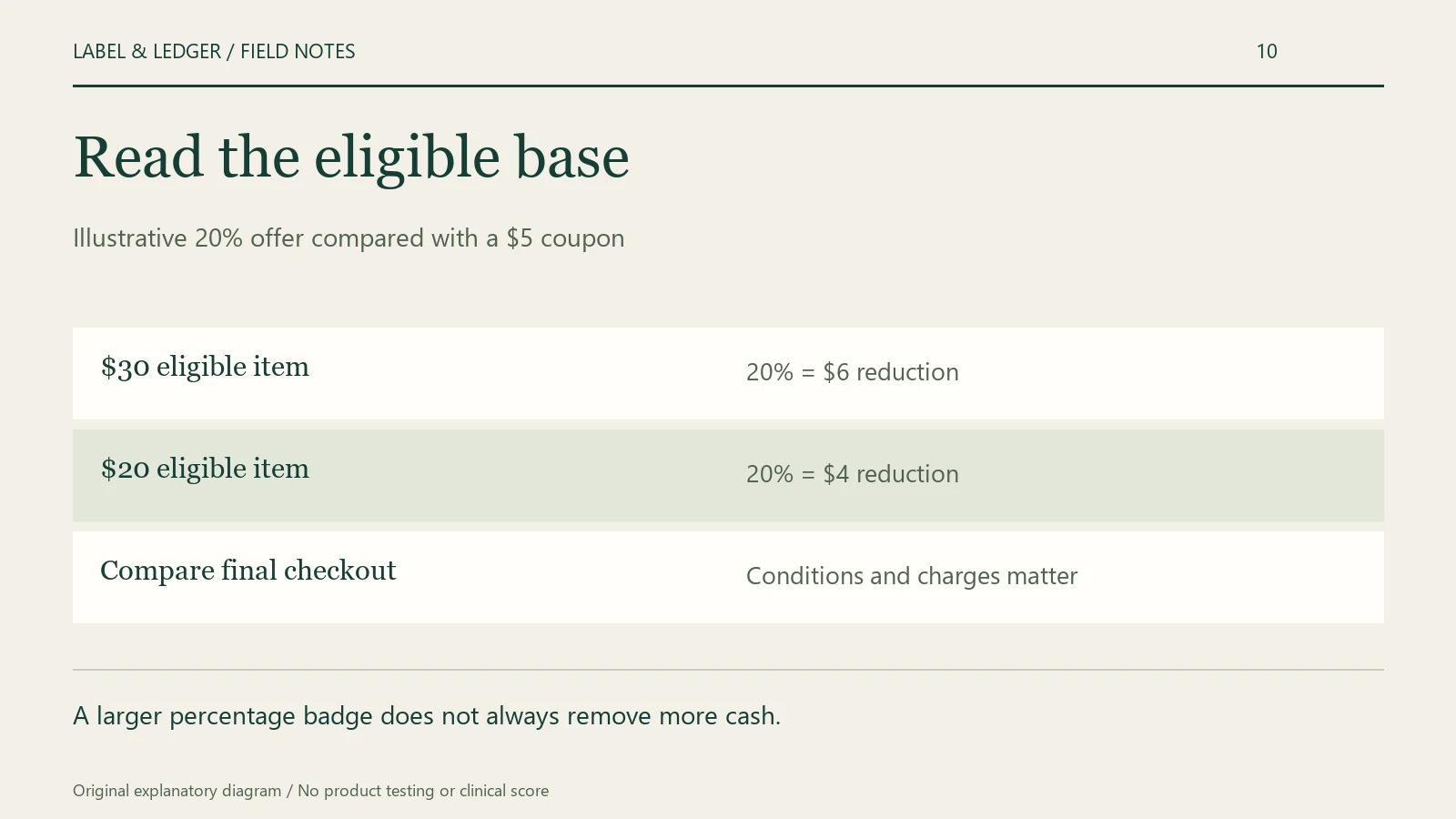
A monthly supplement budget: cash purchases vs. consumption cost
Plan a supplement budget with inventory and whole-package purchases instead of confusing a 30-day cost estimate with the bill due today.
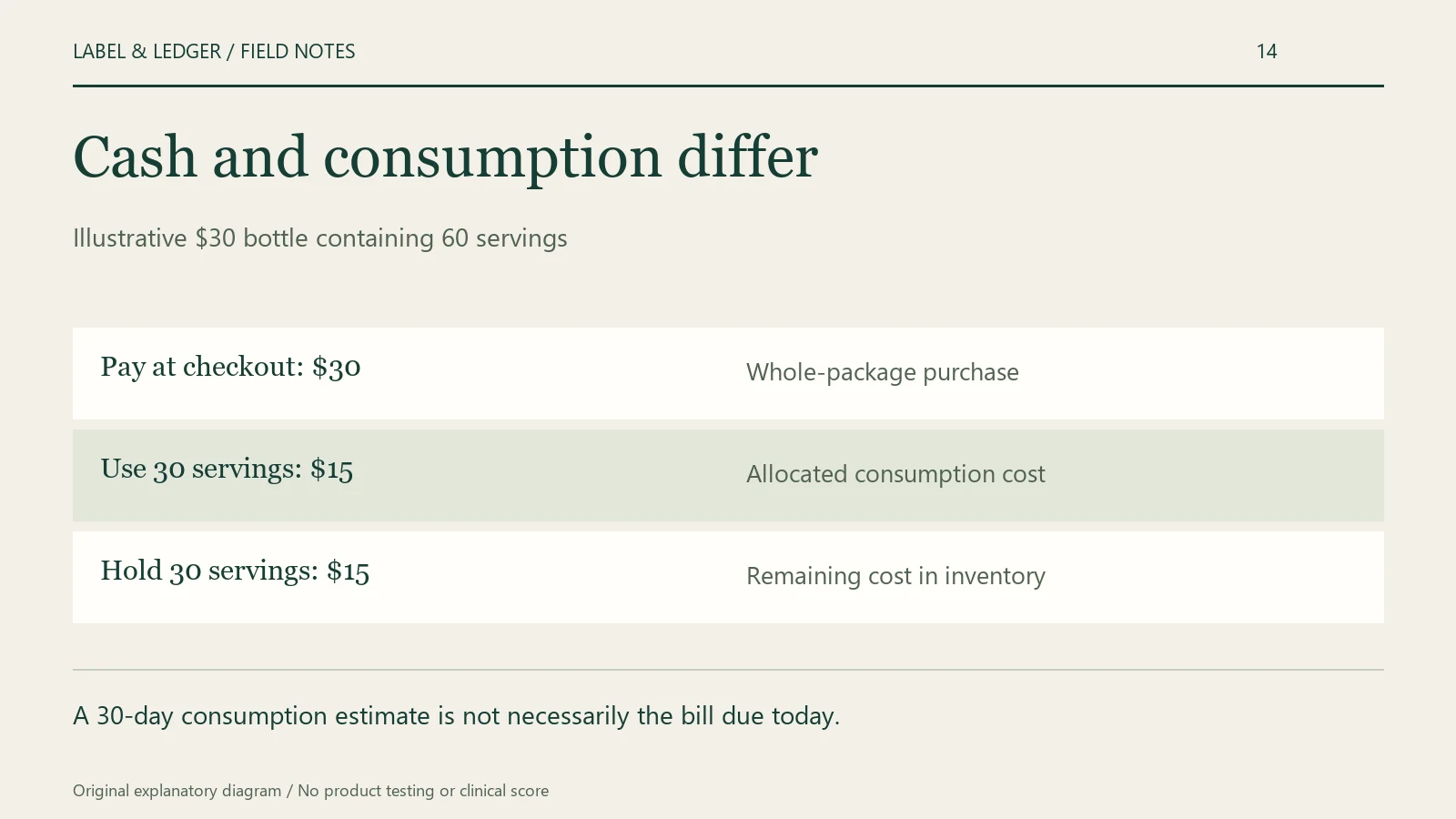
A monthly supplement budget needs two views: the cash paid for whole packages and the cost allocated to the servings used during the period. They can differ substantially when a bottle lasts more than one month. Keep both, along with starting inventory and expected use. The calculator's 30-day figure is a consumption estimate, not a forecast of your credit-card bill or advice about what supplements to use.
Choose a period and an existing use assumption
Decide whether your worksheet represents a fixed 30-day period or a calendar month. A calendar month can have a different number of days, so state the boundary rather than using the word monthly without explanation. For each product, use the appropriate personal plan established outside the price worksheet. This site cannot determine what you need or how often you should take it.
Inventory is part of the starting position. Record the servings already available before deciding how many packages to buy. If you have more than enough for the period, consumption cost may be positive while new purchase cash is zero. That does not make the product free; it means the relevant cash was spent in an earlier period. A useful budget keeps those periods connected.
Calculate consumption cost
For each product, multiply cost per labeled serving by expected servings used during the period. In an illustrative example, a $30 bottle with 60 servings has a $0.50 serving cost. At an assumed one serving per day for a 30-day period, allocated consumption cost is $15. If a separate product costs $0.20 per serving under its own entered assumptions and 30 servings are used, its allocated cost is $6.
The illustrative combined consumption total is $15 + $6 = $21. This does not say which products should be combined. It merely demonstrates adding independent budget lines. Personal questions about overlapping ingredients belong with a qualified healthcare professional. Keep those questions outside the budget total so a low combined price is not mistaken for endorsement of the combination.
Calculate whole-package purchases
Subtract starting servings from planned use to find additional servings needed, with a minimum of zero. Divide that shortfall by servings per package and round purchases up to a whole package. If you need 35 additional servings and each package contains 30, the purchase requirement is two packages, not 1.1667 packages. Any remaining servings become closing inventory in the scenario.
For an illustrative $12, 30-serving package, buying two costs $24 before other charges and supplies 60 servings. If only 35 are used during the period, 25 remain. The allocated cost of the 35 used servings is $14 at $0.40 each. Showing $24 cash and $14 consumption is not a contradiction; they measure different parts of the same plan.
| Illustrative budget line | Quantity | Meaning |
|---|---|---|
| Additional servings needed | 35 | Use not covered by starting stock |
| Packages bought | 2 | Whole packages rounded up |
| Purchase cash | $24 | Money required for those packages |
| Closing inventory | 25 servings | Supply carried into the next period |
| Allocated consumption cost | $14 | Cost of the 35 servings used |
Add delivery and discount timing
Allocate actual shipping and tax consistently when calculating package unit cost. For cash flow, include the charges on the order where they are paid. If several products share shipping, reconcile your item allocations to the total charge. Keep a one-time coupon in the purchase period where it actually applies rather than assuming every refill receives it.
If future prices are not known, label them as planning assumptions. You may choose separate unchanged-price and higher-price scenarios to inspect budget sensitivity, but do not present either as a forecast. No current retailer price database supports these examples. Replace every example with your own package, checkout and schedule information before using the worksheet for a personal purchase plan.
Handle subscriptions as scheduled receipts
A subscription may deliver before you need another package. Put expected receipts on the inventory timeline rather than assuming every delivery is immediately consumed. If stock accumulates, examine the purchase interval and terms. Do not change intake to match billing. A planned pause or skip should remain an assumption until you have actually confirmed it with the relevant seller.
For a calendar budget, record the specific scheduled charge dates within the period. A delivery interval shorter than a calendar month can create different numbers of charges across months. Avoid dividing an annual total by 12 when your immediate question is how much cash leaves the account this particular month. Annual averages and actual monthly cash are both useful when labeled correctly.
Review the budget without turning it into medical advice
If the cash requirement exceeds your budget, list the unresolved purchasing choices and discuss personal use questions with an appropriate professional. The worksheet cannot decide which medically relevant item to stop or change. It can show where inventory, packaging and delivery timing affect spending. That information can support a clearer conversation without pretending to prescribe a regimen.
At period end, compare expected purchases, actual purchases and closing inventory. Preserve the original assumptions so you can see whether the difference came from price, timing or use. Updating a planning model is useful; rewriting history to match it is not. A small, accurate ledger will usually be more informative than a polished savings percentage with unclear boundaries.
FAQ
Why is the calculator's 30-day figure lower than checkout?
It allocates the package cost to 30 days of entered use. Checkout may require buying supply for a longer period.
Should I round every daily cost to cents first?
Keep unrounded values during arithmetic and round the final displayed totals. Early rounding can accumulate errors.
Can the budget tell me what to stop taking?
No. It handles purchasing arithmetic. Discuss changes in personal use with an appropriate healthcare professional.
Sources
- NIH ODS: Dietary supplements, what you need to know — context for personal-use discussions. Budget formulas and all amounts above are original illustrative arithmetic.