Shipping and tax: include the checkout costs without double counting
Calculate a supplement purchase total and choose a consistent method for allocating order-wide charges across several items.
Use the amount actually payable to obtain the selected package, including applicable shipping and tax, when calculating its checkout cost. If several products share an order-wide charge, allocate that charge consistently and label the allocation as your method. Do not treat a free-shipping threshold as proof that adding another product saves money. This guide provides accounting methods, not a statement of any state's tax treatment or a current retailer's terms.
Start with a single-item order
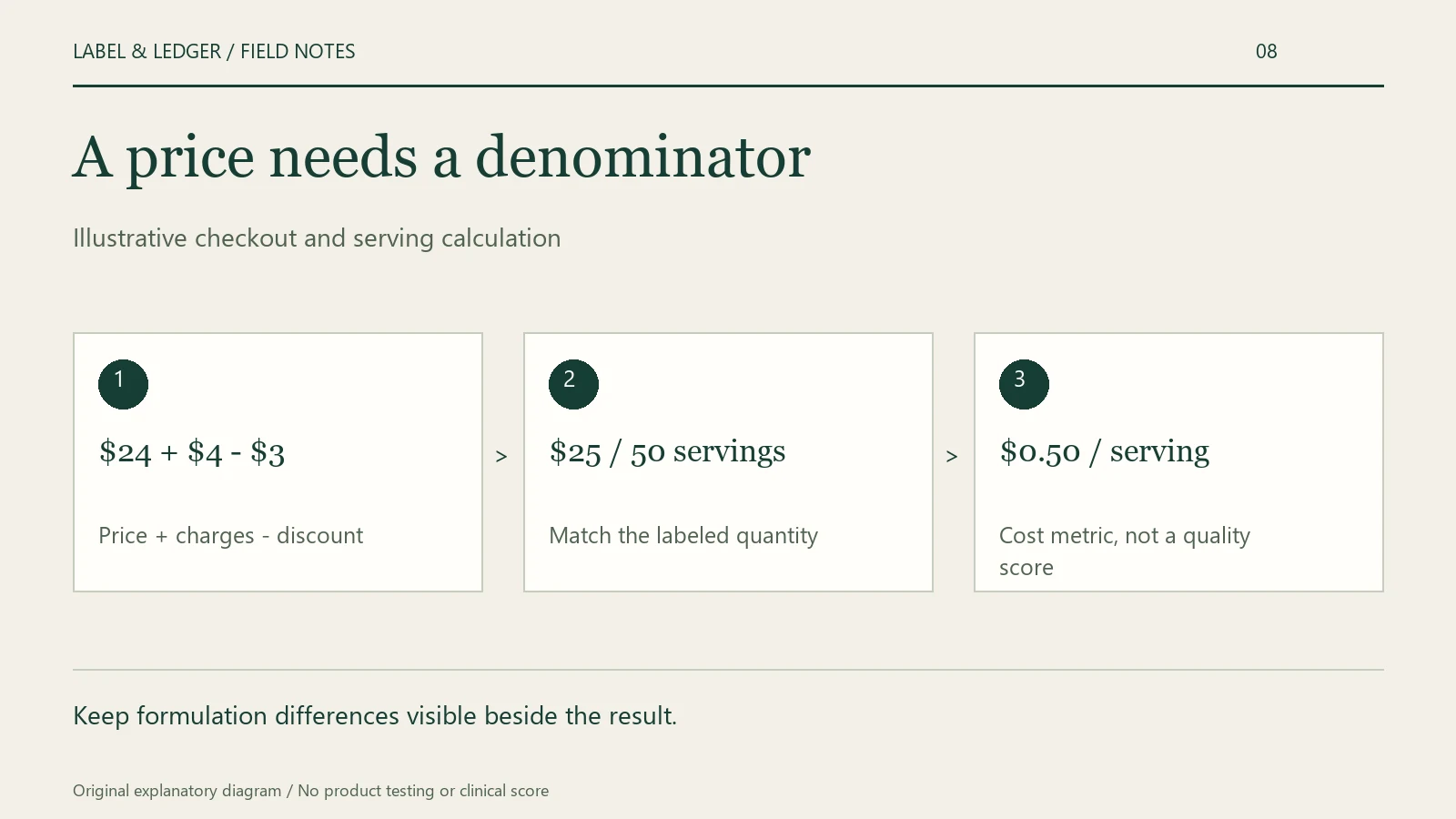
The simplest case has one item, one actual discount and the checkout charges shown for your delivery address. An illustrative $20 bottle with $5 shipping, $1.50 tax and a $2 discount costs $24.50 in total. Write each amount on its own line. Use the final checkout total as a cross-check, since a discount may change the taxable amount or interact with retailer conditions.
Do not infer tax from a generic nationwide percentage. Tax treatment and the final calculation depend on the applicable circumstances; this website supplies no current rate table. The tool's charges field accepts the amount you enter from your checkout. If you are only planning and do not yet have a final total, mark charges as estimated and keep that scenario distinct from an observed payable amount.
Choose a shared-charge method
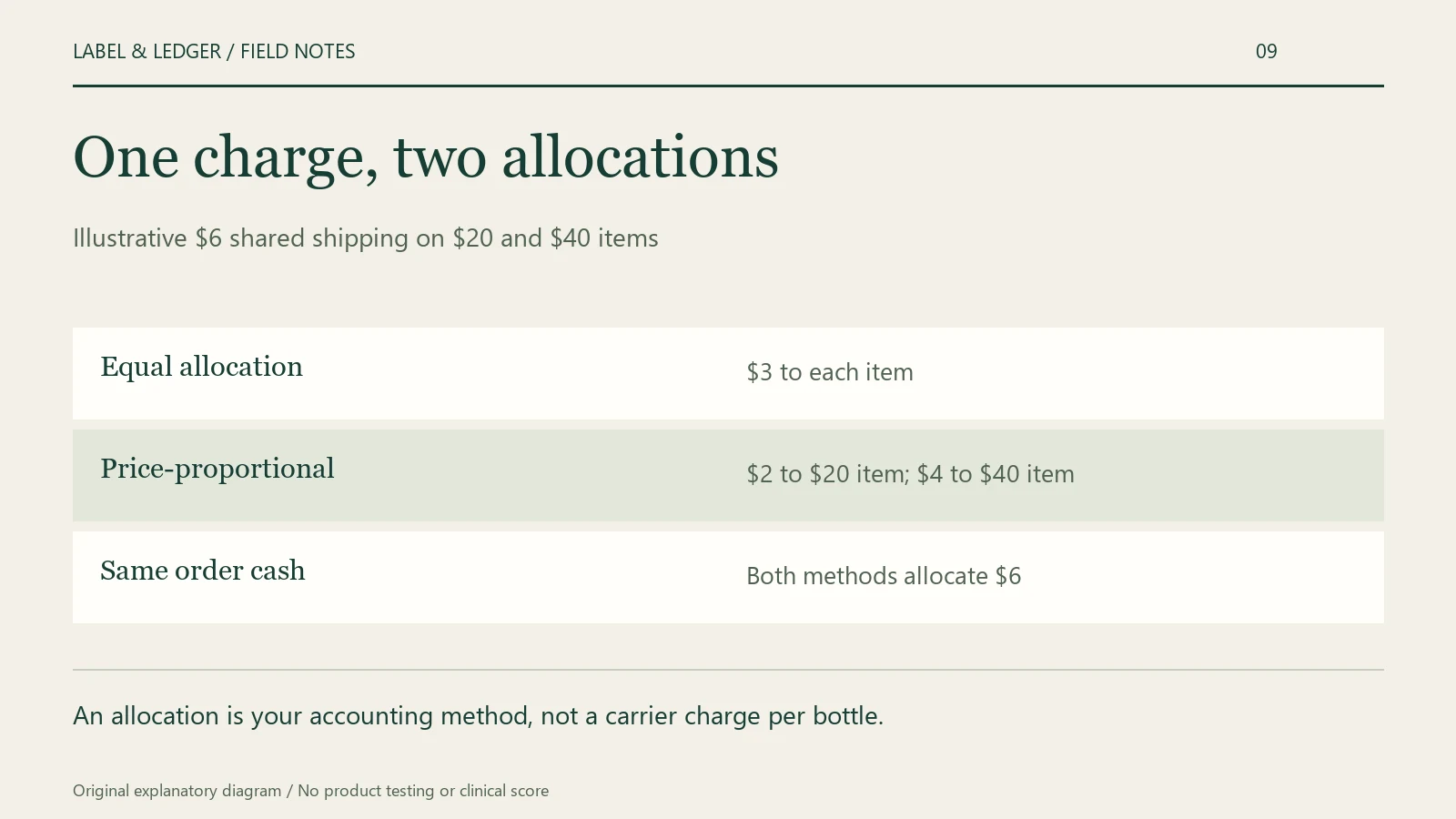
For a mixed order, you may allocate shipping equally across items or in proportion to their item prices. Neither is a statement that the carrier charged each bottle that amount. It is a bookkeeping choice. Equal allocation is easy to inspect; proportional allocation assigns more of the charge to a more expensive item. Pick the method that fits your question and apply it consistently.
For an illustrative order containing a $20 bottle and a $40 bottle with $6 shared shipping, equal allocation assigns $3 to each. Price-proportional allocation assigns $2 to the first and $4 to the second because their shares of the $60 merchandise total are one-third and two-thirds. Both allocations sum to $6. The order's total cash payment is unchanged by your allocation choice.
| Illustrative allocation | $20 item | $40 item | Total shipping allocated |
|---|---|---|---|
| Equal across two items | $3 | $3 | $6 |
| Proportional to item price | $2 | $4 | $6 |
Keep actual item-specific charges separate. If checkout explicitly assigns a fee to one product, do not redistribute it as though it were shared. Tax may also appear with item-level detail. Preserve the checkout record first, then explain any allocation you choose for an order-wide amount. This prevents a worksheet convention from being mistaken for a retailer's billing rule.
Check a free-shipping threshold with total spend
Suppose an illustrative planned item costs $24 and shipping is $6, making $30 payable before any other applicable charges. Adding an unplanned $12 item to qualify for free shipping creates a $36 merchandise total. The shipping line fell by $6, but total spend rose by $6. Whether the extra item is useful is a separate question; the order did not become cheaper in cash terms.
Compare two complete baskets rather than comparing only their shipping lines. Include any taxes or offer conditions shown at checkout. If the added item was already needed, consider its role explicitly. If it was not needed, do not allocate its price away until the first item looks artificially cheap. A useful worksheet can show planned purchases and threshold-driven additions separately.
Keep memberships and recurring fees visible
An existing paid membership may affect delivery charges, but its annual fee is not automatically zero because it was paid earlier. For an incremental question about one order, you might show only the additional cash required today. For a full annual shopping budget, you might allocate the membership fee across relevant purchases. State which question you are answering rather than switching methods mid-comparison.
Avoid assuming future order counts solely to make a membership look economical. Use a transparent scenario and test fewer orders as well. The allocation per order equals the relevant fee divided by the assumed number of orders, but that assumption is yours, not a market fact. Keep the full membership cash cost visible alongside any allocated figure.
Prevent double counting
If you enter a final checkout total as the product price, do not add shipping and tax again. Alternatively, enter the item price and put charges in their separate field. Use one approach consistently. A short note beside the input, such as price excludes charges, prevents future confusion. The same principle applies to a price already reduced by a coupon: do not subtract the coupon twice.
When comparing a local purchase with delivery, include only costs you are deliberately measuring. A travel-cost estimate may be appropriate to a broader personal budget, but it should be labeled as a scenario and calculated separately. Do not disguise an assumed travel value as a retailer charge. The purpose of the worksheet is to make boundaries clear enough that another reader can reproduce the result.
Audit the order total
Add allocated item totals and verify that they equal the complete order total within normal currency rounding. If not, look for an unallocated fee, a duplicated discount or a tax amount assigned twice. Preserve cents through the allocation and adjust any rounding remainder explicitly. This arithmetic check is more useful than displaying several decimal places without reconciling the order.
FAQ
Which tax rate should I enter?
Use the amount shown for your actual checkout when available. This guide does not provide a current tax determination.
Does free shipping mean a lower total?
Only a complete basket comparison can answer that. Additional required purchases can increase total spend even when shipping falls to zero.
Is a shared-charge allocation a product fact?
No. It is your accounting method. Label it and keep the original checkout record.
Sources
- USA.gov — starting point for official state and consumer resources. All baskets and allocation figures above are illustrative arithmetic; no retailer terms or state tax rates are asserted.