Ingredient amounts: compare mg, mcg and grams without mixing them
Normalize mass units carefully, preserve the named ingredient and avoid converting activity measures with a generic formula.
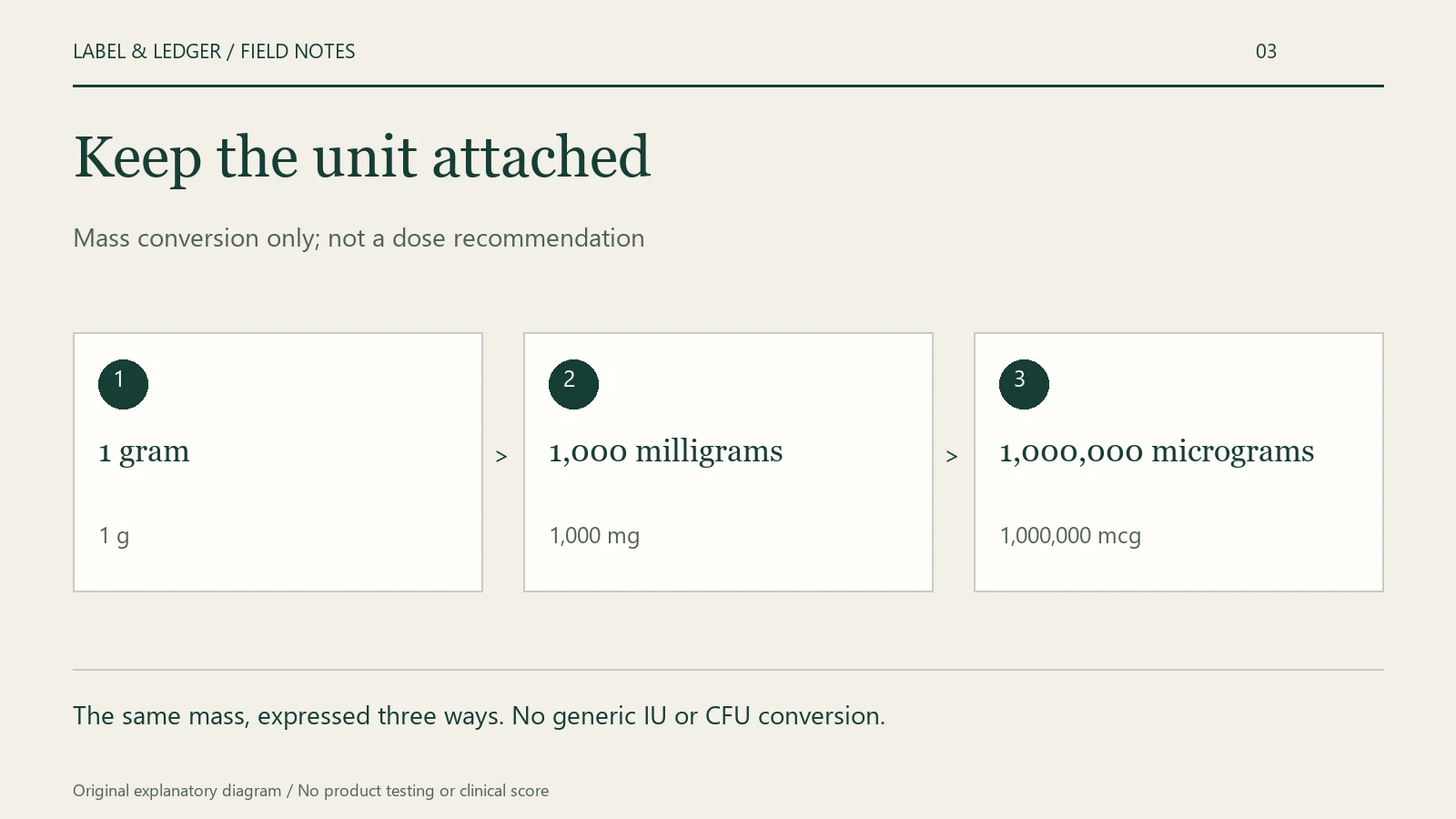
Compare ingredient amounts only after matching both the ingredient identity and the measurement unit. Grams, milligrams and micrograms measure mass: one gram equals 1,000 milligrams or 1,000,000 micrograms. A number without its unit is incomplete. Activity measures, international units and organism counts require different interpretation and must not be pushed through a generic mass conversion. The objective is consistent arithmetic, not choosing an amount to take.
Make the comparison question narrow
Write a sentence such as compare the cost per gram of this named ingredient in these two packages. The name is as important as the unit. An extract, a source plant and a specified component of that extract may represent different quantities. Copy the label wording rather than shortening all three to the familiar plant name. If you cannot establish a common quantity, calculate labeled serving cost instead and describe the information gap.
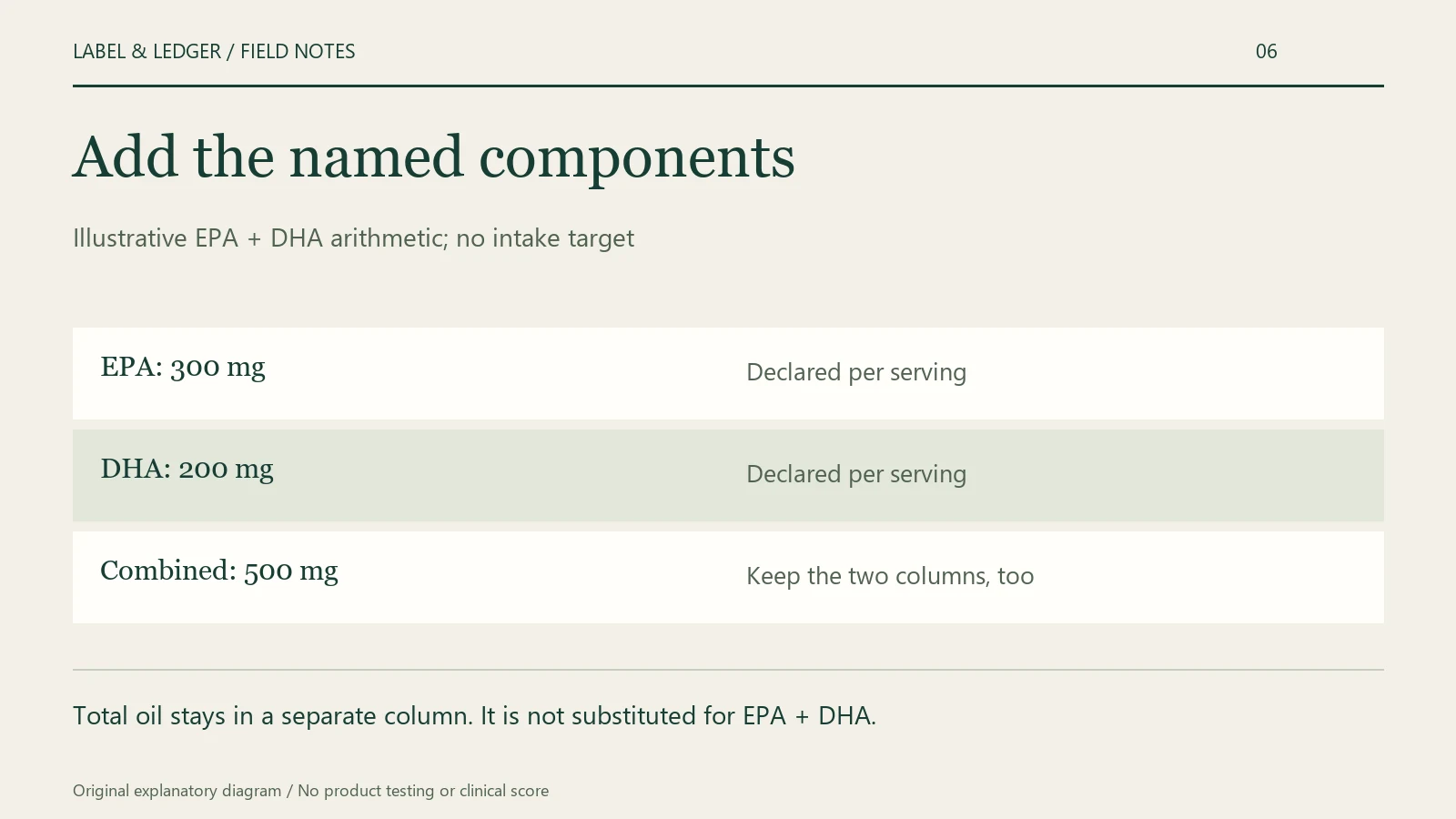
Keep form information beside the amount even when it does not enter the formula. Two rows can have identical mass and still differ in composition or formulation. A spreadsheet should not hide those differences simply because they are nonnumeric. The result may support a narrower statement about price per declared gram while leaving practical equivalence undecided.
Convert once, then calculate
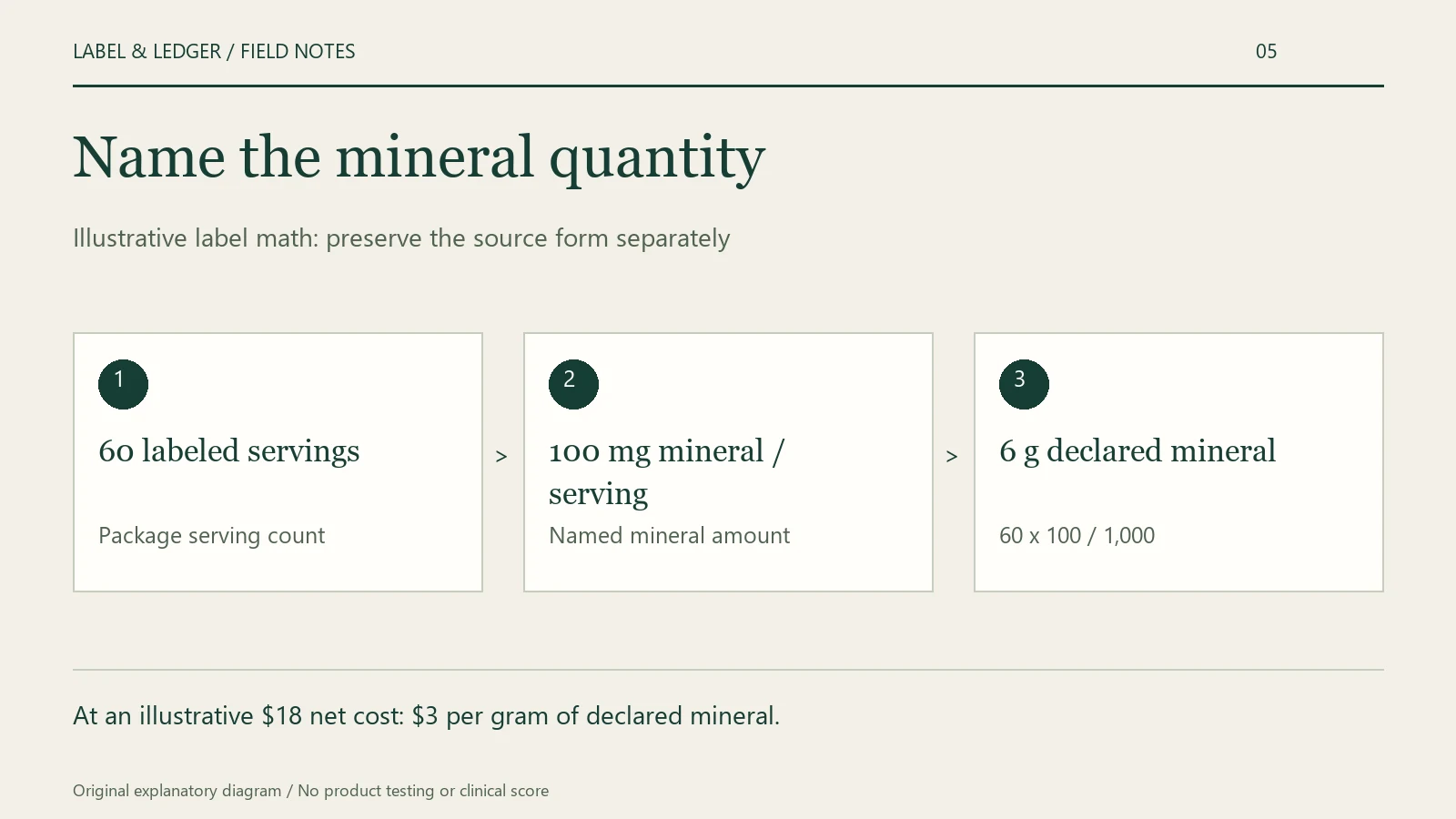
Choose a base unit for the whole worksheet. Grams work conveniently for ingredient unit cost. Divide a milligram amount by 1,000 or a microgram amount by 1,000,000 to express it in grams. Multiply by the number of labeled servings to estimate the declared ingredient mass in the whole bottle. Then divide the net bottle cost by that total mass. Keep unrounded values until the final display.
For an illustrative product with 60 servings and 500 mg of a named ingredient per serving, the declared total is 60 × 500 ÷ 1,000 = 30 g. If the illustrative net price is $30, cost is $30 ÷ 30 = $1 per gram. Nothing in those inputs indicates an appropriate personal dose. They merely make the conversion easy to inspect.
| Input amount | Grams for arithmetic | Conversion |
|---|---|---|
| 1 g | 1 g | No change |
| 500 mg | 0.5 g | Divide by 1,000 |
| 500 mcg | 0.0005 g | Divide by 1,000,000 |
Catch the thousand-fold mistake
The similar-looking abbreviations mg and mcg can produce a thousand-fold difference. Read them from the label at full size rather than a thumbnail. In a worksheet, use a unit column with a controlled choice instead of typing units into the numeric cell. In the ingredient calculator, change the unit selector deliberately and check the resulting total grams against your hand calculation.
Avoid changing both the amount and the unit unless you intend a conversion. If you enter 500 mg and then select grams without changing 500, you have entered a different amount. The tool cannot know whether that was intentional. A confirmation line in your notes, such as 500 mg equals 0.5 g, provides a useful human check independent of the calculator output.
Exclude measures that are not mass
Do not enter CFU as though it were milligrams. Do not use a generic rule to convert IU to grams across ingredients. Do not treat a percentage on a label as a mass until you understand exactly what the percentage refers to. Percent Daily Value is also a different kind of information from grams in the bottle; its interpretation belongs to the label and relevant reference framework, not an arbitrary conversion formula.
If a seller uses an unfamiliar activity unit, request the definition and supporting label information. You may be able to compare two identical formulations on cost per labeled serving without converting the activity measure at all. This is often more honest than manufacturing a common unit that the available data cannot support. State which quantity you could compare and which you could not.
Do not turn a cost metric into a dosing target
A lower price per gram can encourage shoppers to favor a larger amount. That is a purchasing incentive, not a health conclusion. Keep the decision about use outside the unit-cost calculation. A higher concentration could reduce package size or alter serving instructions, but the arithmetic alone cannot say whether that is useful or appropriate. Ask a qualified healthcare professional about personal questions and interactions.
For an existing regimen, record the amount and frequency established with appropriate advice, then evaluate the corresponding purchase cost. Do not work backward from the cheapest gram to a new regimen. If your comparison includes different forms, ask whether the distinction matters before presenting the products as interchangeable. Where uncertainty remains, preserve the separate rows and avoid a single winner label.
Audit the final result
Check that ingredient amount is per serving, not per capsule, before multiplying by servings. Check that net cost includes only the package being measured. Write the conversion factor in the worksheet so another reader can reproduce the answer. Finally, read the result aloud with its full unit: dollars per gram of the named declared ingredient. That wording prevents the result from drifting into a broader quality claim.
FAQ
Can I compare 1,000 mcg with 1 mg?
As mass amounts, they are equal. Ingredient identity and formulation still need separate comparison.
Does the calculator handle IU?
No. It intentionally accepts only g, mg and mcg, so it cannot imply a universal activity conversion.
Is price per gram better than price per serving?
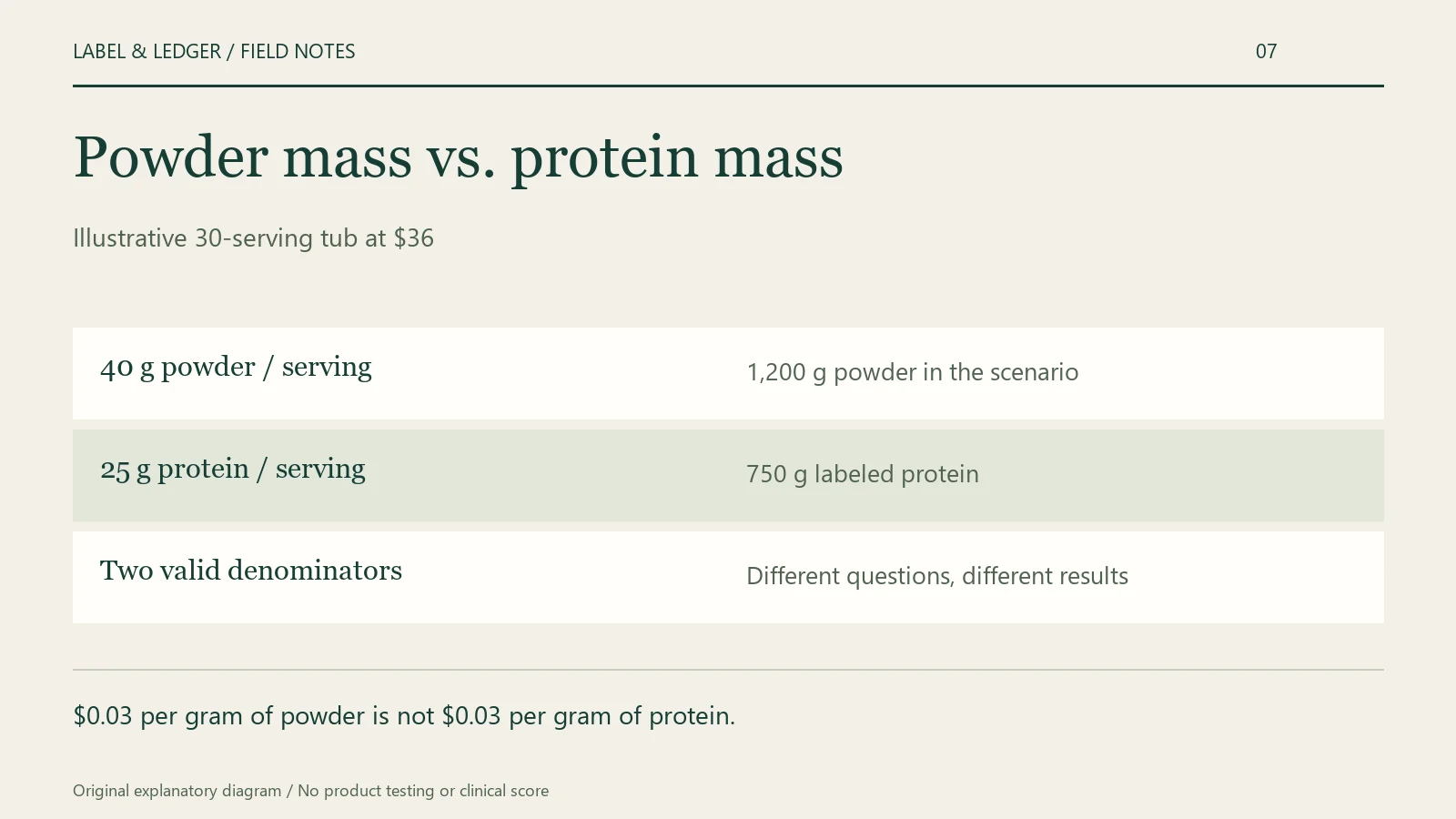
They answer different questions. Choose the metric that matches your question and explain its limits.
Sources
- FDA: Supplement Facts nutrition labeling guide — declared quantities and units on labels.