Fish oil and algal oil: compare the EPA and DHA amounts you mean
Keep total oil, EPA, DHA and serving size separate so that an omega-3 cost comparison answers a clearly defined question.
If your comparison is specifically about EPA and DHA, use the quantities of EPA and DHA declared on the label rather than the total oil amount. Record each quantity and the serving size before calculating a combined denominator. A large oil number alone does not establish how much of either component is included. This is a method for organizing label and price information, not a recommendation to take omega-3 supplements.
Name the components in your worksheet
NIH ODS identifies ALA, EPA and DHA as distinct omega-3 fatty acids. Keep the names visible rather than collapsing every entry into omega-3. A worksheet for a particular question might have columns for total oil, EPA, DHA and labeled serving size. Another question might require a different layout. Do not assume that a product mentioning an omega-3 category supplies every component in a quantity useful for your comparison.
Use the exact label for the selected package. A seller title may highlight total oil while a rear image provides component details. If the image is unreadable or belongs to another bottle count, request a current panel. Do not copy an EPA or DHA amount from another strength in the same product family. Similar branding is not evidence that the formulation is identical.
Calculate a defined component total
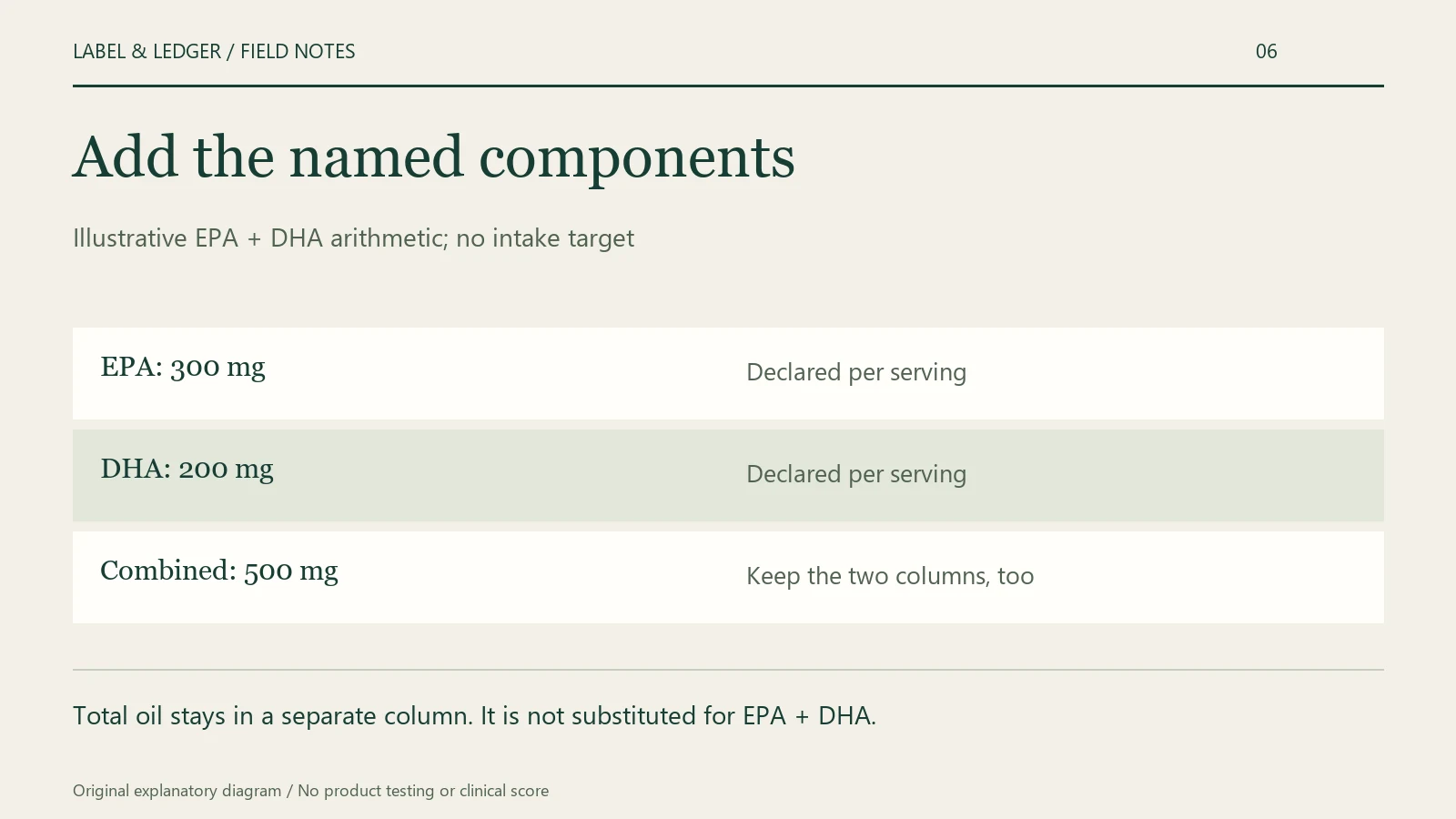
In an illustrative example, a labeled serving declares 300 mg EPA and 200 mg DHA. Adding those specific quantities gives 500 mg EPA plus DHA per labeled serving. With 60 servings, the declared combined amount is 60 × 500 = 30,000 mg, or 30 g. At an illustrative $30 net bottle cost, that is $1 per gram of the declared combined components and $0.50 per serving.
Keep the original EPA and DHA columns after adding the combined total. Two products can have the same combined amount with different proportions. Combining the numbers is a convenience for a particular price question, not proof that the formulations are identical. If the balance of components matters to a personal plan, ask a qualified healthcare professional how to frame the comparison.
| Illustrative label field | Amount per serving | Use in this calculation |
|---|---|---|
| Total oil | Recorded separately | Not substituted for EPA plus DHA |
| EPA | 300 mg | Included in named combined total |
| DHA | 200 mg | Included in named combined total |
| EPA plus DHA | 500 mg | Explicit comparison denominator |
Keep source and formulation separate from price
Write whether the product is described as fish oil, algal oil or another source, and preserve other formulation details given on its label. A cost-per-gram output does not evaluate source preferences, composition, additional ingredients or suitability. It cannot establish that a less expensive row is a substitute for another row. Those differences belong beside the numbers, where they can be considered rather than hidden.
Do not infer EPA or DHA content from a source name alone. Do not assume that a front-label total includes only the components you care about. When a product quantifies a broader total but not the individual components, mark the component-level result as unavailable. You can still calculate cost per labeled serving, explicitly identifying that narrower comparison and the remaining information gap.
Avoid capsule and serving mistakes
Component amounts may be stated per labeled serving that includes more than one softgel. Multiply by servings per bottle, not the raw softgel count, unless you have first converted the amount to a per-softgel basis. A double-count error can make a product appear to contain twice the declared amount. Read the serving-size line immediately before entering EPA and DHA in your worksheet.
For liquids, preserve the labeled volume basis. If a serving is measured by a volume unit, do not substitute a household estimate without understanding the actual label instructions. For price calculations you may use stated servings per container, while recording that the label describes an approximate count if applicable. This guide does not set a use schedule or advise changing a serving to obtain a lower daily cost.
Separate research questions from checkout questions
The official ODS fact sheet is a starting point for ingredient background, not a validation of any particular seller or bottle. Keep a separate record of claims made about the product and the evidence offered for them. If a product makes a promise relevant to a medical condition or medicine decision, take the exact wording and label to a healthcare professional. A clean price spreadsheet cannot resolve that clinical question.
For checkout, capture the actual price, shipping, tax allocation and discount conditions. A subscription teaser may apply only to the first order. Keep the first-order and refill costs separate, then use the same component denominator for each. If the formulation changes between orders, revisit the label rather than assuming the old unit cost still applies to the new package.
Finish with a precise sentence
Report the result as cost per gram of declared EPA plus DHA in the specified package, at the entered price. Include the serving count and the date of your own price capture in your personal record. This wording makes the scope inspectable. Avoid shorthand such as cheapest omega-3 unless you have defined the market, quantities and comparable products, which this site does not do.
FAQ
Can total fish oil replace EPA plus DHA in the formula?
Not if EPA plus DHA is your stated comparison target. Use the component amounts or mark the calculation unresolved.
Are equal combined amounts identical formulations?
No such conclusion follows from addition. Preserve the individual component amounts and other label differences.
Does this guide provide an intake target?
No. The numbers are illustrative arithmetic inputs. Personal use requires an appropriate discussion with a healthcare professional.
Sources
- NIH ODS: Omega-3 fatty acids consumer fact sheet — component definitions, sources and health considerations.