Powder weight vs. protein weight: choosing a fair price denominator
Compare a tub price per gram of labeled protein without confusing total powder mass, scoop size and the nutrient amount.
For a price comparison about protein, divide the purchase cost by the declared grams of protein in the package, not automatically by the total weight of powder. Total powder mass and protein mass are different measures. Keep serving weight, protein per serving and servings per container in separate columns. The calculation can clarify a shopping question, but it cannot decide whether a product or protein intake is appropriate for you.
Identify what the panel describes
First note whether the product presents Nutrition Facts or Supplement Facts, and preserve its actual category and wording. Do not rewrite a conventional food as a dietary supplement merely because it is a powder. Read the protein amount per serving from the panel, then record the serving mass and approximate number of servings. A familiar tub shape does not supply any of those inputs.
Check that the flavor and size match the selected listing. Different flavors or formulations may have different serving masses or declared protein amounts. A comparison that uses the price of one variant and the panel of another is not reproducible. Save the exact label image and checkout line together, especially when a marketplace combines multiple options under one product page.
Work through two denominators
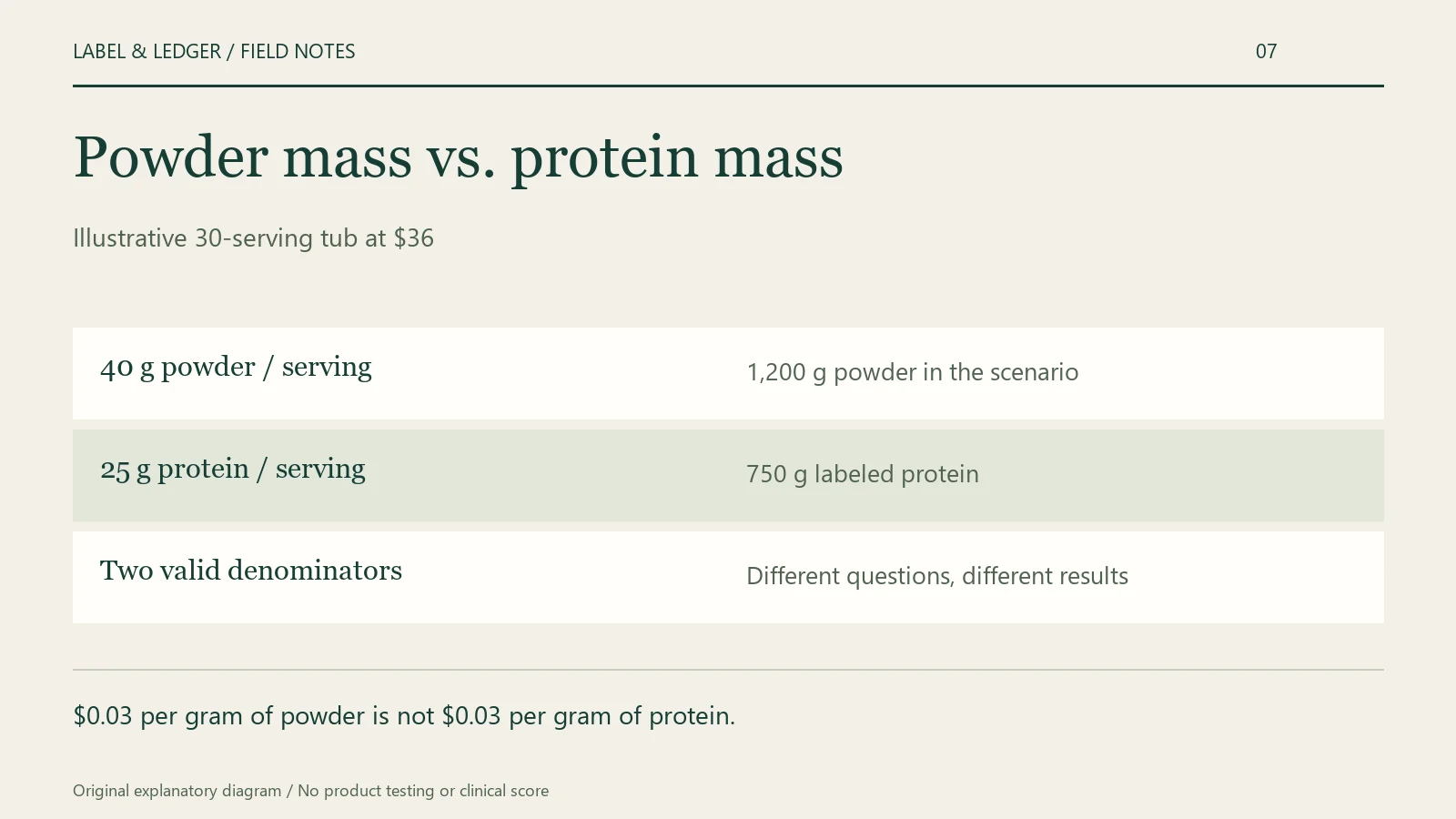
Consider an illustrative tub costing $36, with 30 servings, a 40 g serving mass and 25 g of labeled protein per serving. Total declared protein is 30 × 25 = 750 g. The cost is $36 ÷ 750 = $0.048 per gram of labeled protein. Cost per serving is $36 ÷ 30 = $1.20. The implied powder mass from those serving inputs is 1,200 g, subject to any label rounding.
Dividing $36 by 1,200 g instead gives $0.03 per gram of powder. That number is not wrong if it is clearly labeled, but it answers a different question. Calling it cost per gram of protein would be wrong. Preserve both denominators if you want to compare package economics and a named nutrient. Explain which one you used when sharing a result.
| Illustrative measure | Arithmetic | Result |
|---|---|---|
| Labeled protein in tub | 30 × 25 g | 750 g |
| Serving cost | $36 ÷ 30 | $1.20 |
| Protein unit cost | $36 ÷ 750 g | $0.048/g |
| Powder unit cost | $36 ÷ 1,200 g | $0.03/g |
Do not assume every scoop is interchangeable
A scoop is part of the product's measuring arrangement, not a universal unit shared by every tub. Compare declared grams rather than the appearance of a scoop in a photograph. If the label provides both scoop count and serving mass, copy both. The scoop description helps you interpret instructions, while grams help keep the price calculation consistent across packages.
Do not infer precise serving counts from how full a scoop looks. For the shopping worksheet, use the stated servings and any approximation language. If you are reconciling the total package mass with serving mass, describe the result as a cross-check. A small discrepancy may reflect declared rounding, while an obvious mismatch could indicate a wrong label image. Request clarification instead of forcing the numbers to fit.
Compare formulation attributes alongside cost
Protein source, flavor, other ingredients and label warnings may matter to the person choosing a product. Record them without assigning an unsupported quality score. A lower dollar amount per gram does not assess tolerability, composition, convenience or personal dietary needs. A formula that contains the same total protein may still differ in ways that your arithmetic does not measure.
Where you have a medical condition, an allergy concern, or a professionally directed nutrition plan, use the actual package information in a discussion with an appropriate healthcare professional. This guide gives no universal intake recommendation. The illustrative 25 g figure is a convenient input for a worked example, not a target for every person or a claim that one product category is necessary.
Include waste and the full checkout
If you expect to leave part of a tub unused, advertised total protein is not the only useful budget denominator. You can separately calculate expected usable servings and the cost per expected used serving. Clearly label this as your scenario, since the unused fraction is not an observed product defect. Do not reduce the declared protein total in the factual label record; keep the waste assumption in its own column.
Shipping may change the comparison between a small tub and a bulk offer. Allocate shared order charges consistently and explain your method. If a discount requires a bundle, use the relevant total spend and note the additional products. A low apparent protein unit cost can be misleading if it depends on purchasing items you did not intend to buy. Keep checkout cash and allocated consumption cost visible together.
Create a reproducible shortlist
For each row, retain exact variant, net price, serving count, serving mass, protein per serving and the calculated total. Add a link or private screenshot reference to the label you used. Recalculate when changing any input. Finish by checking that cost per gram multiplied by total labeled protein returns the net purchase cost before display rounding. This is a simple way to catch a lost zero or swapped unit.
FAQ
Is the tub's net weight the protein total?
Not automatically. Use labeled protein per serving multiplied by labeled servings when your question is about protein mass.
Should I compare only cost per serving?
It is useful, but serving sizes can differ. Report the amount represented by each serving as well.
Does the tool assess protein quality?
No. It performs unit-cost arithmetic and does not evaluate composition, effectiveness or personal requirements.
Sources
- FDA: Questions and answers on dietary supplements — distinction between supplements and conventional foods.
- FDA: Supplement Facts nutrition labeling guide — panel quantity reference.